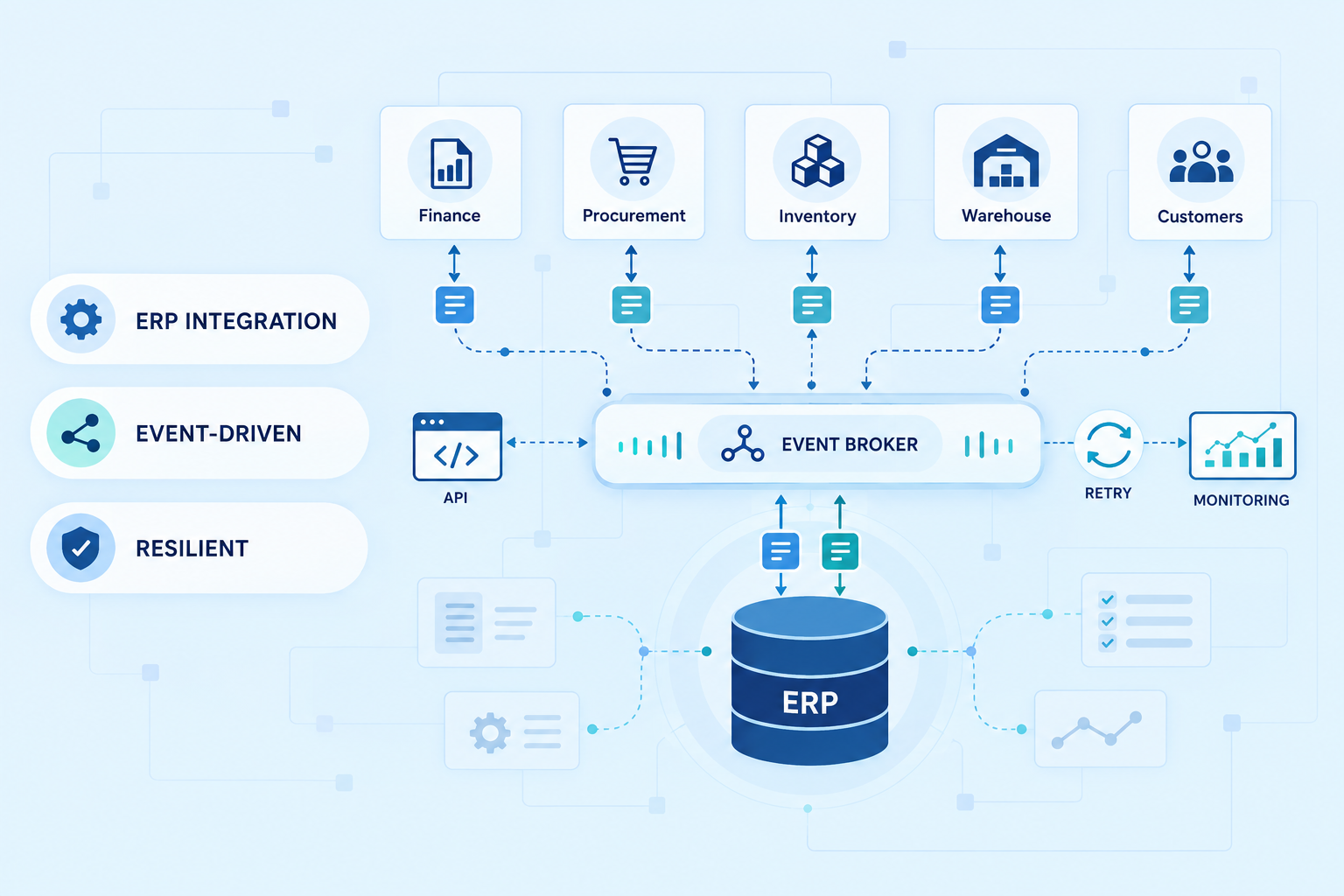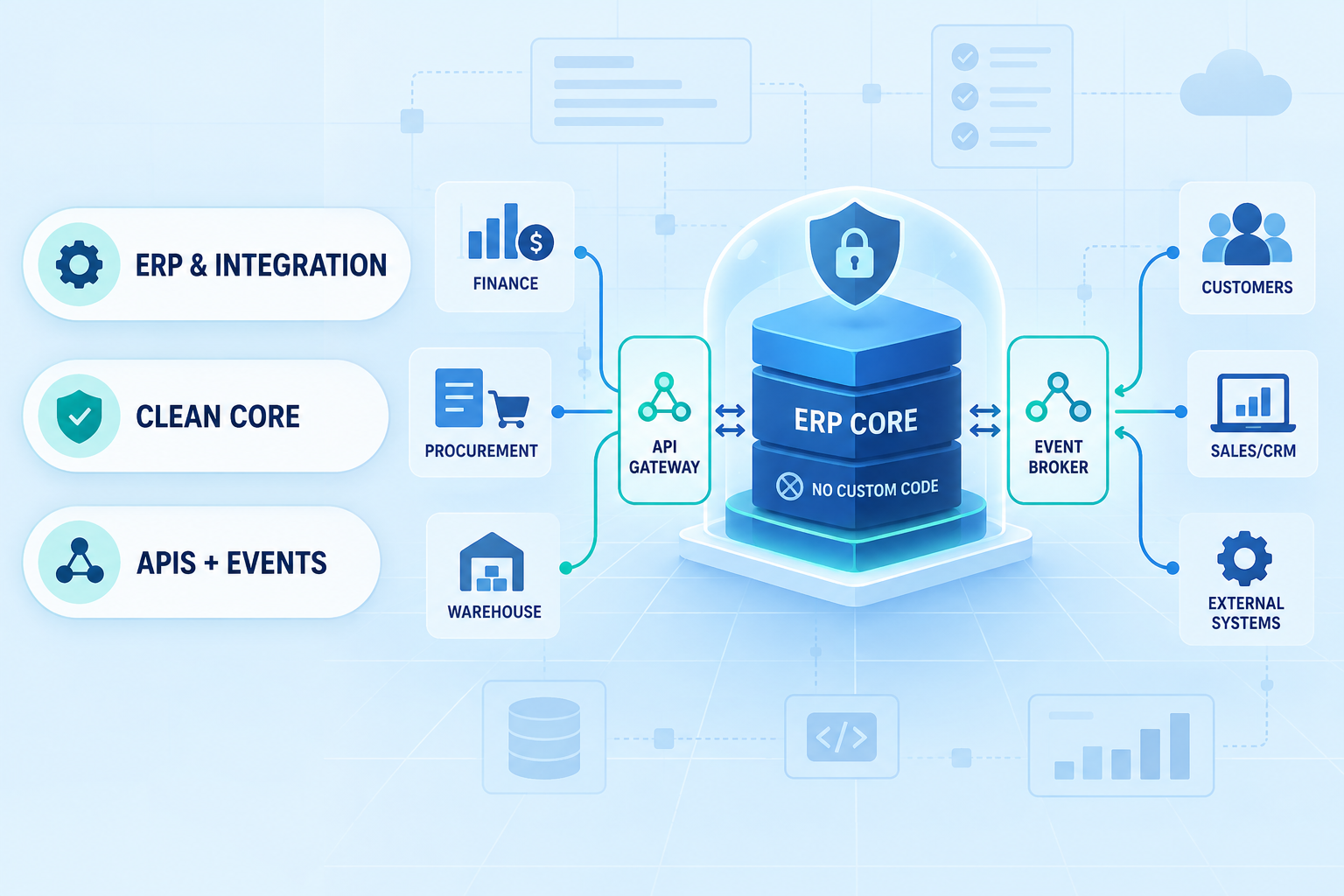

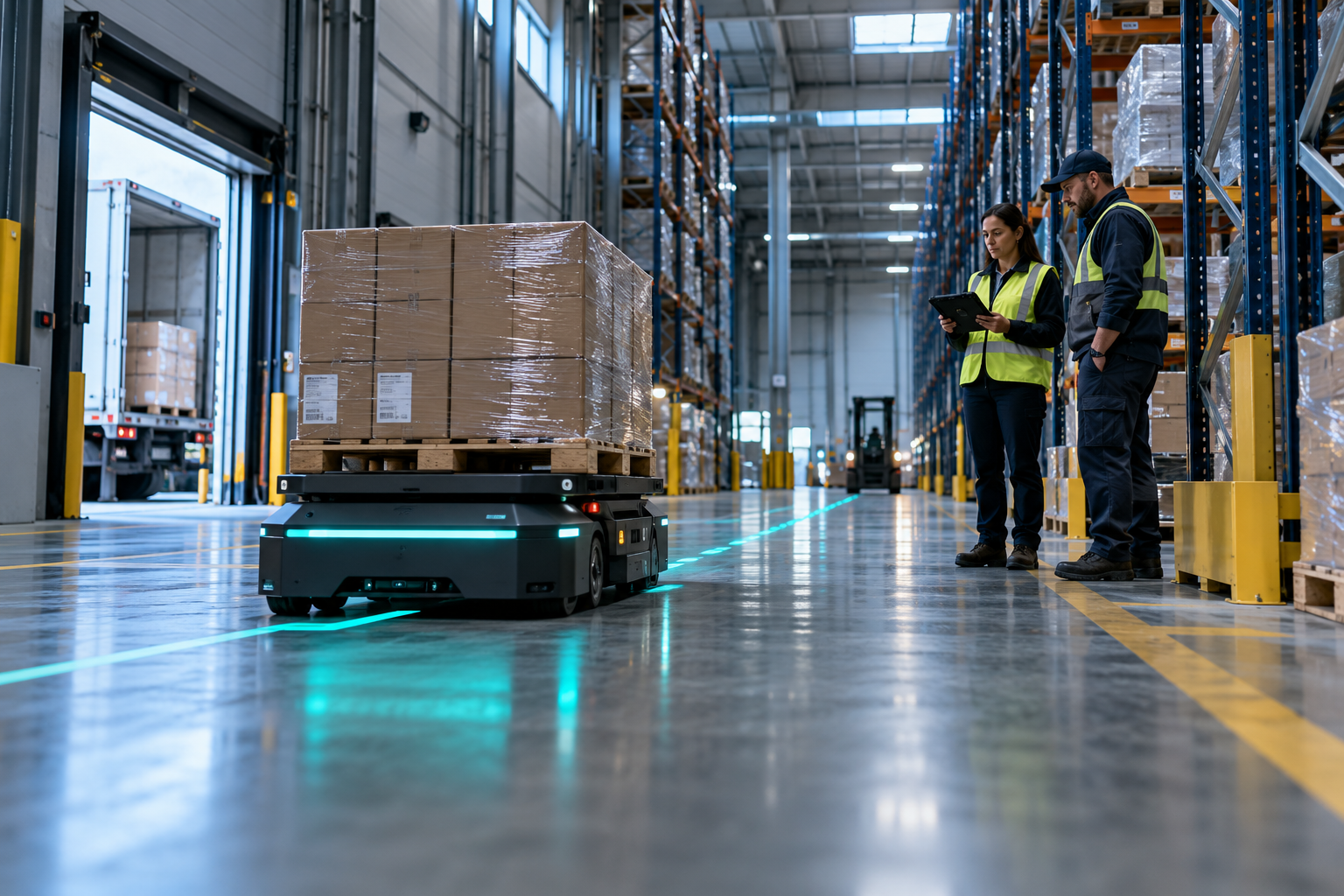
SAP’s recent physical-AI announcement describes linking robots and other physical systems with enterprise processes, including inbound storage tasks and warehouse transport missions. The practical promise is compelling: an ERP or EWM task can become a robot mission, and completion can return as a governed business event rather than a manual update.
That connection also raises the consequence of integration errors. A wrong bin, stale map or duplicated task is no longer only bad data; it can move inventory or equipment in the real world. Go-live therefore needs controls across ERP, edge, fleet management and the physical workspace.
1. Define the system of record
ERP or EWM should own the business task, stock and bin state. A fleet manager may own navigation and robot assignment. Document which system can create, cancel, reroute and complete work, and how conflicts are resolved. Avoid two systems independently deciding the destination.
2. Align maps with master data
SAP onboarding guidance requires warehouse maps to contain storage-bin information accessible to robots. Version the physical map, ERP bin master and robot configuration together. Validate blocked aisles, temporary staging areas, height and weight limits, and charging locations before releasing work.
3. Make commands idempotent
Every mission needs a stable identifier and lifecycle: proposed, accepted, executing, completed, failed or cancelled. Retries must not create duplicate movement. Correlate robot status with warehouse order and task so inventory posts only after the defined physical confirmation.
4. Design safe operating boundaries
Robots must meet navigation and collision-avoidance requirements, but site controls remain essential. Define zones, speed, pedestrian crossings, emergency stops, manual takeover and maintenance lockout. Safety validation belongs with qualified engineering and operations teams, not the software interface alone.
5. Handle connectivity loss
Decide what the robot does when edge, fleet or ERP connectivity disappears. It may finish a bounded motion, move to a safe location or stop. Queue status without inventing completion. Reconcile every in-flight mission when service returns before releasing new work.
6. Include energy and capacity
Battery thresholds, charging points and robot availability affect throughput. SAP documentation notes autonomous charging settings and reassignment of unfinished work. Feed capacity into dispatching instead of discovering shortages in the aisle. Measure charging congestion and mission distance.
7. Keep people in exception control
Supervisors need one view of business task, physical location, robot status and recovery action. Train operators to pause, reassign and investigate without creating shadow movements. Capture overrides and near misses as improvement data.
The takeaway: physical AI creates value when business intent and physical execution remain synchronized. The best integration is not the one with the most autonomous motion; it is the one that makes every mission safe, traceable, recoverable and economically useful.
From announcement to dependable operations
Start with a bounded business problem and an accountable owner. Record the current cost, delay, failure rate, and manual work before changing the architecture. Define a measurable outcome, but do not present an estimate as guaranteed savings. Include security, finance, operations, and the people who will support exceptions after launch.
Map the current workflow before selecting technology. Identify the source of truth, approval points, downstream consumers, sensitive data, recovery objectives, and every manual workaround. Decide which step the new capability improves and which steps remain unchanged. This prevents a demonstration from being mistaken for an end-to-end operating solution.
Build a representative pilot with real permissions, data volume, dependency behavior, and user roles. Test peak demand, missing data, stale configuration, denied access, duplicate input, partial failure, recovery, and rollback. Document what continues when the new capability is unavailable. Keep an approved manual path for high-consequence decisions.
Security must be part of the design. Use separate workload identities, short-lived credentials, least privilege, encrypted transport and storage, controlled secrets, and auditable administrative access. Treat retrieved documents, event payloads, model output, and third-party responses as untrusted input. Validate every action at the boundary where it affects money, data, equipment, customers, or regulated records.
Cost controls need similar depth. Tag usage to a product and owner, define budgets and anomaly thresholds, measure cost per successful business outcome, and include integration, support, data movement, licensing, and training. A lower infrastructure bill can be offset by more exceptions or human correction. Evaluate total process cost rather than one service price.
Operate the result like a product. Monitor availability, latency, unit cost, data quality, security findings, user adoption, exceptions, and support effort. Version configurations and decision rules. Log changes and approvals. Review whether the capability still solves the original problem as prices, products, and workflows evolve.
Prepare the support model before launch. Give responders dashboards, runbooks, ownership, escalation paths, and safe diagnostic access. Alert on stale data and silent degradation, not only complete failure. Practice a dependency outage and verify that queued work, retries, reconciliation, and user communication behave as designed.
Change management is also technical risk control. Explain what users should trust, what they must verify, and how they report a wrong result. Train with real scenarios and capture overrides as useful feedback. Do not measure adoption by logins alone; measure whether the process becomes faster, safer, or more accurate.
Maintain a decision record that states why the technology was selected, which alternatives were considered, which risks were accepted, and what would trigger redesign or retirement. Review it after incidents and major vendor changes. Portability does not require avoiding managed services; it requires knowing which data, contracts, identities, and operational procedures must survive a change.
Expansion should follow evidence. Compare the pilot with its baseline, include the cost of integration and governance, and retire components that no longer earn their complexity. A new feature creates value only when teams can understand it, control it, recover it, and improve it without depending on one specialist.
Finally, schedule a formal review after thirty and ninety days. Ask whether users changed behavior, whether exceptions moved elsewhere, and whether actual costs match the forecast. Publish the findings to sponsors and delivery teams. If value is weak, narrow the scope or stop. Responsible innovation includes the ability to end an experiment cleanly.
Sources
- SAP News — Physical AI extends the autonomous enterprise into the real world
- SAP Help — Onboarding robots for integration services
Build it with Cogniquaint experts
Cogniquaint’s ERP, IoT and industrial-integration experts can map warehouse and robot responsibilities, design mission APIs and edge recovery, align bin and map data, integrate fleet status with EWM, and build human-centered safety and exception controls for a measured physical-AI rollout.
Work with Cogniquaint
Ready to elevate your operations with AI-powered insights?
Get in touch with us to build your next intelligent solution.