

Seasonal traffic turns ordinary pipeline weaknesses into visible business failures. A DAG that finishes comfortably on Tuesday can miss its service window when clickstream volume multiplies, upstream files arrive together, or a retry storm consumes every worker slot. The worst moment to discover an unbounded task or hidden quota is during the sale.
Google Cloud recently described load testing Managed Service for Apache Airflow at elevated traffic and using agentic capabilities to diagnose failures, assess upgrade compatibility and inspect environment health. The useful lesson is broader than one platform: AI can accelerate investigation, but peak resilience still comes from measured workload limits, observable dependencies and practiced recovery.
Define the business deadline
For every critical DAG, record when source data is available, when the output becomes useful, and what happens if it is late. Inventory feeds, fraud features, recommendations and finance exports have different consequences. Prioritize by lost decision time rather than by DAG size.
Set a recovery objective and a maximum acceptable data age. A pipeline can be technically running while downstream teams act on stale information.
Replay a realistic traffic shape
Use production distributions for event size, partition keys, file arrival, skew and late data. Include ramp-up, sustained peak and abrupt bursts. Multiplying every metric by eight is less useful than reproducing the actual bottleneck pattern.
Run tests in an isolated environment with production-like quotas, packages and network paths. Mask sensitive data or use representative synthetic fixtures. Record the exact test version so improvements can be repeated.
Find the real constraint
Watch scheduler delay, queued tasks, worker CPU and memory, database connections, API quotas, storage throttling and downstream concurrency. A worker increase cannot fix a source that permits ten connections or a task serialized on one hot partition.
Measure task duration percentiles and critical-path completion, not only average runtime. Rare slow partitions often decide whether the business deadline is met.
Design bounded retries
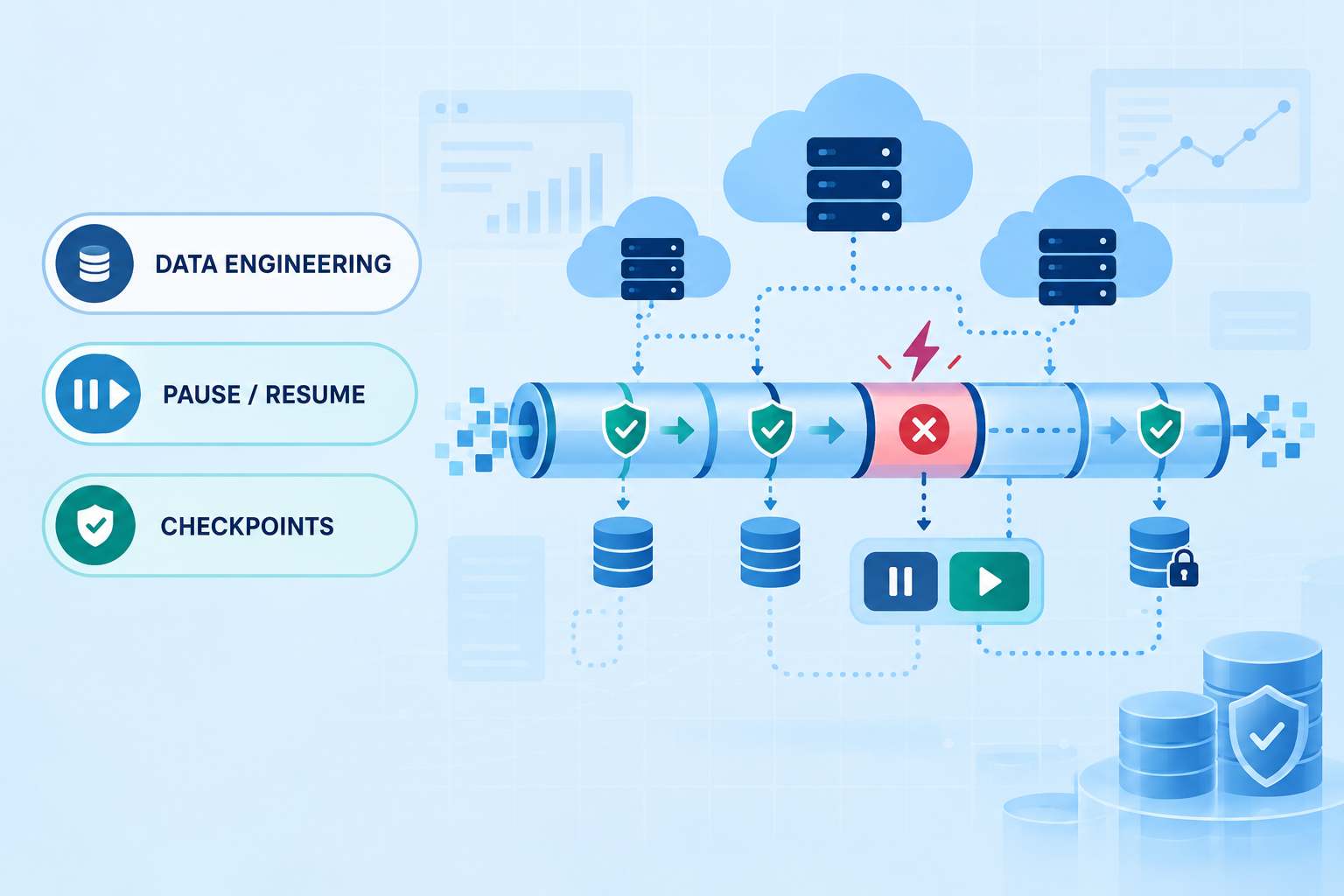
Classify transient, capacity, data-quality and code failures. Use exponential backoff and jitter where appropriate. Cap retries and route irrecoverable records to a reviewed exception path. A fast retry loop can amplify an outage and crowd out healthy work.
Make tasks idempotent. Replaying an order, inventory or billing task must not duplicate its business effect.
Use the agent as an investigator
An Airflow troubleshooting agent can gather task logs, scheduler signals and environment metrics, then suggest likely causes. Require evidence links and keep mutation behind review. The agent should never resize production, clear tasks or change a DAG simply because a plausible explanation was generated.
Review data residency and access. Diagnostic conversations and external developer agents may follow policies different from the orchestration environment. Use dedicated service identities, narrow permissions and audited sessions.
Rehearse the upgrade before peak
Package, provider and Airflow version changes can affect serialization, scheduling and operator behavior. Use compatibility assessment, then run the critical DAG suite on the candidate image. Freeze avoidable upgrades during the high-risk window and document emergency exceptions.
Create operator-ready runbooks
For each critical failure, state the signals, first safe action, owner, escalation, replay method and business communication. Include a degraded mode: pause nonessential DAGs, reduce refresh frequency or prioritize the most valuable region. Practice with the people who will be on call.
Measure readiness, not confidence
Track tested peak multiple, headroom, oldest queued task, critical-path completion, recovery time, retry volume and manual interventions. Re-run after material DAG, dependency or infrastructure changes. A green test from last season is not permanent evidence.
The takeaway: peak events reward disciplined orchestration. AI can compress diagnosis from scattered clues, but capacity testing, idempotency, safe retries and rehearsed decisions are what keep data useful when traffic stops behaving normally.
From announcement to dependable operations
Start with a bounded business problem and an accountable owner. Record the current cost, delay, failure rate, and manual work before changing the architecture. Define a measurable outcome, but do not present an estimate as guaranteed savings. Include security, finance, operations, and the people who will support exceptions after launch.
Map the current workflow before selecting technology. Identify the source of truth, approval points, downstream consumers, sensitive data, recovery objectives, and every manual workaround. Decide which step the new capability improves and which steps remain unchanged. This prevents a demonstration from being mistaken for an end-to-end operating solution.
Build a representative pilot with real permissions, data volume, dependency behavior, and user roles. Test peak demand, missing data, stale configuration, denied access, duplicate input, partial failure, recovery, and rollback. Document what continues when the new capability is unavailable. Keep an approved manual path for high-consequence decisions.
Security must be part of the design. Use separate workload identities, short-lived credentials, least privilege, encrypted transport and storage, controlled secrets, and auditable administrative access. Treat retrieved documents, event payloads, model output, and third-party responses as untrusted input. Validate every action at the boundary where it affects money, data, equipment, customers, or regulated records.
Cost controls need similar depth. Tag usage to a product and owner, define budgets and anomaly thresholds, measure cost per successful business outcome, and include integration, support, data movement, licensing, and training. A lower infrastructure bill can be offset by more exceptions or human correction. Evaluate total process cost rather than one service price.
Operate the result like a product. Monitor availability, latency, unit cost, data quality, security findings, user adoption, exceptions, and support effort. Version configurations and decision rules. Log changes and approvals. Review whether the capability still solves the original problem as prices, products, and workflows evolve.
Prepare the support model before launch. Give responders dashboards, runbooks, ownership, escalation paths, and safe diagnostic access. Alert on stale data and silent degradation, not only complete failure. Practice a dependency outage and verify that queued work, retries, reconciliation, and user communication behave as designed.
Change management is also technical risk control. Explain what users should trust, what they must verify, and how they report a wrong result. Train with real scenarios and capture overrides as useful feedback. Do not measure adoption by logins alone; measure whether the process becomes faster, safer, or more accurate.
Maintain a decision record that states why the technology was selected, which alternatives were considered, which risks were accepted, and what would trigger redesign or retirement. Review it after incidents and major vendor changes. Portability does not require avoiding managed services; it requires knowing which data, contracts, identities, and operational procedures must survive a change.
Expansion should follow evidence. Compare the pilot with its baseline, include the cost of integration and governance, and retire components that no longer earn their complexity. A new feature creates value only when teams can understand it, control it, recover it, and improve it without depending on one specialist.
Finally, schedule a formal review after thirty and ninety days. Ask whether users changed behavior, whether exceptions moved elsewhere, and whether actual costs match the forecast. Publish the findings to sponsors and delivery teams. If value is weak, narrow the scope or stop. Responsible innovation includes the ability to end an experiment cleanly.
Sources
- Google Cloud Blog — Scaling Airflow pipelines with AI agents
- Google Cloud documentation — Agentic capabilities in Managed Airflow
Build it with Cogniquaint experts
Cogniquaint’s data engineering experts can model peak workloads, stress-test Airflow environments, identify scheduler and dependency bottlenecks, design safe retry and replay behavior, integrate governed troubleshooting agents, and rehearse incident runbooks with your data and operations teams.
Work with Cogniquaint
Ready to elevate your operations with AI-powered insights?
Get in touch with us to build your next intelligent solution.