

A large ERP migration can become an expensive relocation project: move custom code, interfaces, duplicate master data and inconsistent processes to new infrastructure, then discover that upgrades remain slow and innovation remains risky. Cloud hosting changes the operating model, but it does not clean the core automatically.
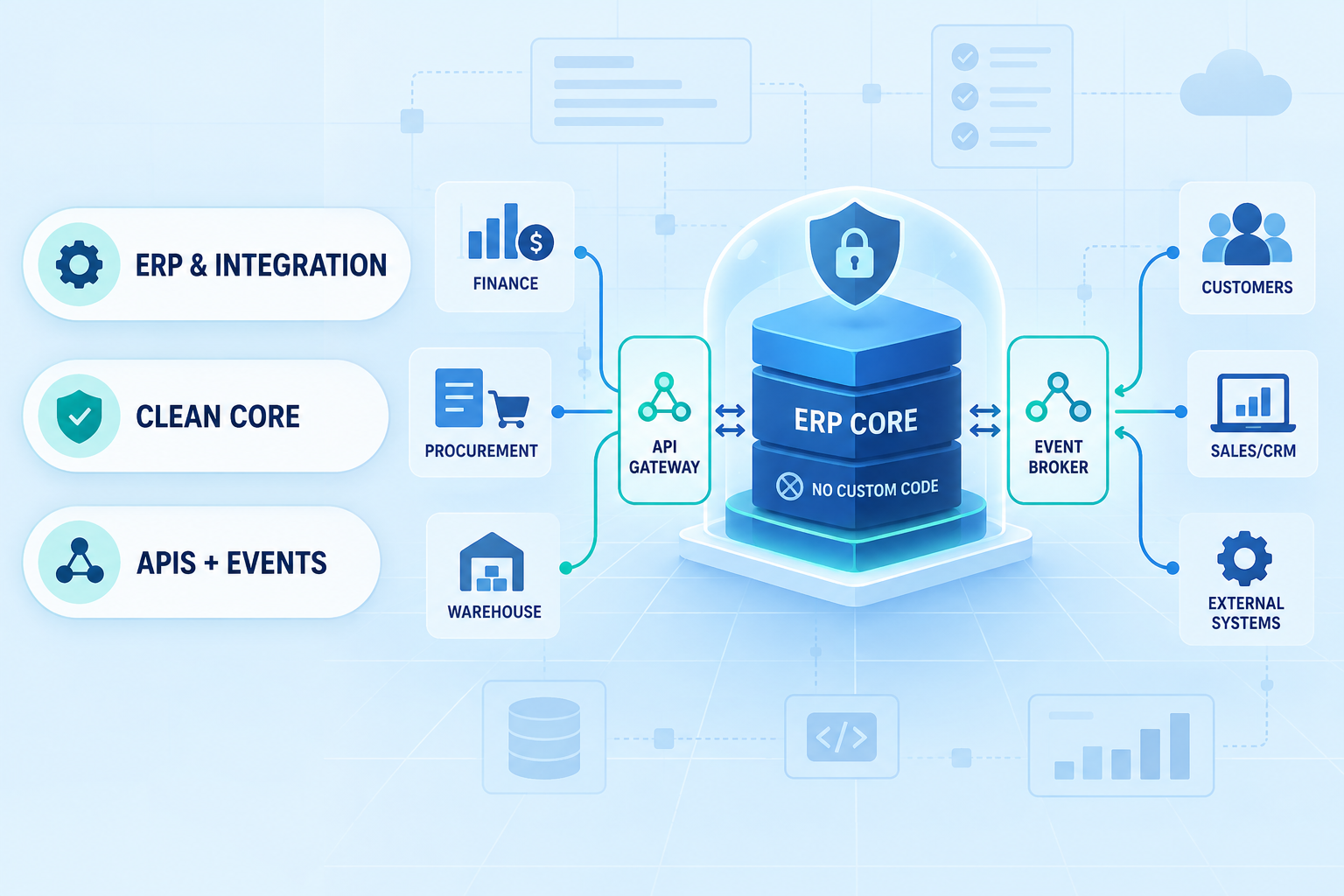
SAP’s announcement that AstraZeneca is moving a large life-sciences estate from SAP ERP Central Component to SAP Cloud ERP Private emphasizes simplification, standardization, harmonized data and connected processes. SAP’s clean-core guidance recommends standard processes where possible, upgrade-stable in-app extensions for simple needs, and side-by-side extensions and integrations for more complex or cross-system capabilities. The practical lesson applies to any ERP: decide what deserves to move before deciding how.
Define “clean” across the whole core
Custom code is only one dimension. Inventory software versions, extensions, integrations, data, business processes and operational practices. A standard ERP with poor master data and hundreds of undocumented interfaces is not clean.
Set measurable goals: fewer unused modifications, released interfaces, owned integrations, complete master data, standardized process variants, automated monitoring and predictable upgrades.
Classify every customization by business value
For each object, identify users, executions, revenue or compliance impact, last change, replacement in standard software and upgrade effort. Retire unused items. Return commodity processes to standard. Preserve true differentiation only with a named business owner.
Do not let “we have always had it” become a requirement. Reconfirm the outcome with current users and regulators. Many custom reports and approvals survive because nobody owns the decision to remove them.
Choose the least coupled extension
Use key-user or in-app extensibility for small fields, forms and local logic that the platform supports safely. Use approved on-stack development when transaction consistency, legal rules or performance genuinely require it. Put complex, multi-system, mobile or independently released capabilities side by side behind stable APIs.
Document why each choice was made, its lifecycle and replacement trigger. New standard functionality may later allow a custom extension to be deleted.
Modernize integration contracts
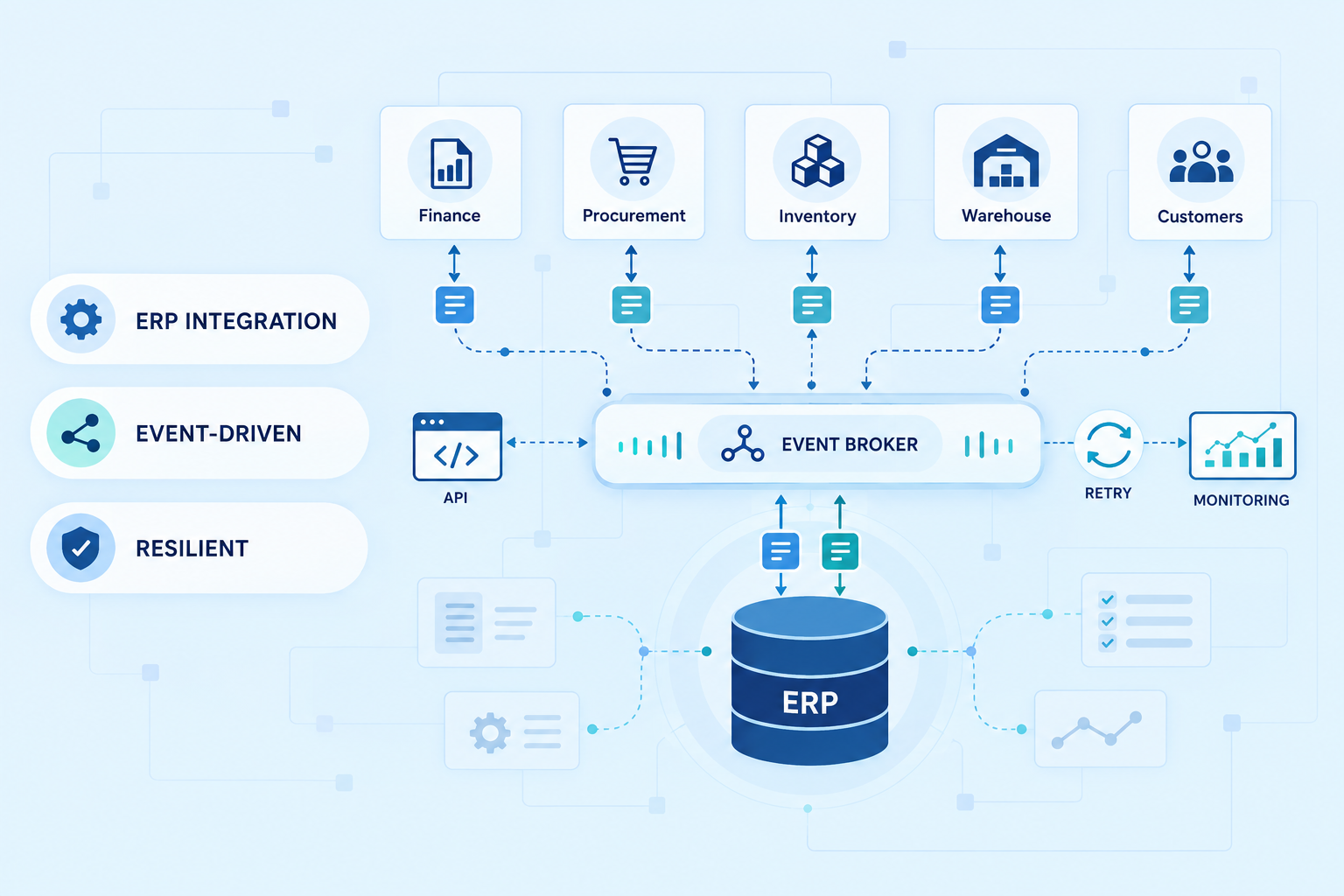
Inventory RFCs, IDocs, files, database links, APIs and events. Prefer released, versioned interfaces and asynchronous patterns where appropriate. Define schema ownership, idempotency, error handling, replay, monitoring and security. Avoid recreating a point-to-point web around the new ERP.
Keep plant, laboratory, warehouse and partner constraints realistic. Some systems have intermittent connectivity or strict sequence rules. Use edge buffering and reconciled workflows instead of pretending every process is continuously online.
Harmonize data before cutover
Assign owners for customer, supplier, material, asset and finance masters. Resolve duplicates, units, classifications, obsolete records and country requirements. Measure completeness and correctness by migration wave. Loading bad data faster only makes the cloud system fail more consistently.
Standardize with controlled exceptions
Create a global process template and identify where regulation, market or product differences require variation. Put exception requests through a cross-functional standardization board. Record cost, owner, scope and review date. Local teams need a credible route for genuine needs, not a blanket “no.”
Protect regulated operations
Life-sciences and manufacturing migrations must preserve validation evidence, electronic records, segregation of duties, batch traceability and controlled change. Map critical processes to tests and approvals. Separate technical migration success from business and quality release.
Cut over by business capability
Use waves with data rehearsal, interface contract tests, role validation, end-to-end process tests and rollback. Include month-end, recalls, returns, production exceptions and disconnected-site recovery. Stabilize each wave before expanding.
Govern the core after go-live
A clean core can become customized again. Establish architecture standards, automated checks, extension inventory, API lifecycle management and periodic deletion reviews. Measure upgrade effort, incidents caused by custom objects, integration failures, process variants and time to adopt new releases.
The takeaway: cloud ERP creates value when migration reduces the weight carried forward. Preserve differentiation through governed extensions and stable integration, while standardizing the core, data and processes that should never have been unique.
From announcement to dependable operations
Start with a bounded business problem and an accountable owner. Record the current cost, delay, failure rate, and manual work before changing the architecture. Define a measurable outcome, but do not present an estimate as guaranteed savings. Include security, finance, operations, and the people who will support exceptions after launch.
Map the current workflow before selecting technology. Identify the source of truth, approval points, downstream consumers, sensitive data, recovery objectives, and every manual workaround. Decide which step the new capability improves and which steps remain unchanged. This prevents a demonstration from being mistaken for an end-to-end operating solution.
Build a representative pilot with real permissions, data volume, dependency behavior, and user roles. Test peak demand, missing data, stale configuration, denied access, duplicate input, partial failure, recovery, and rollback. Document what continues when the new capability is unavailable. Keep an approved manual path for high-consequence decisions.
Security must be part of the design. Use separate workload identities, short-lived credentials, least privilege, encrypted transport and storage, controlled secrets, and auditable administrative access. Treat retrieved documents, event payloads, model output, and third-party responses as untrusted input. Validate every action at the boundary where it affects money, data, equipment, customers, or regulated records.
Cost controls need similar depth. Tag usage to a product and owner, define budgets and anomaly thresholds, measure cost per successful business outcome, and include integration, support, data movement, licensing, and training. A lower infrastructure bill can be offset by more exceptions or human correction. Evaluate total process cost rather than one service price.
Operate the result like a product. Monitor availability, latency, unit cost, data quality, security findings, user adoption, exceptions, and support effort. Version configurations and decision rules. Log changes and approvals. Review whether the capability still solves the original problem as prices, products, and workflows evolve.
Prepare the support model before launch. Give responders dashboards, runbooks, ownership, escalation paths, and safe diagnostic access. Alert on stale data and silent degradation, not only complete failure. Practice a dependency outage and verify that queued work, retries, reconciliation, and user communication behave as designed.
Change management is also technical risk control. Explain what users should trust, what they must verify, and how they report a wrong result. Train with real scenarios and capture overrides as useful feedback. Do not measure adoption by logins alone; measure whether the process becomes faster, safer, or more accurate.
Maintain a decision record that states why the technology was selected, which alternatives were considered, which risks were accepted, and what would trigger redesign or retirement. Review it after incidents and major vendor changes. Portability does not require avoiding managed services; it requires knowing which data, contracts, identities, and operational procedures must survive a change.
Expansion should follow evidence. Compare the pilot with its baseline, include the cost of integration and governance, and retire components that no longer earn their complexity. A new feature creates value only when teams can understand it, control it, recover it, and improve it without depending on one specialist.
Finally, schedule a formal review after thirty and ninety days. Ask whether users changed behavior, whether exceptions moved elsewhere, and whether actual costs match the forecast. Publish the findings to sponsors and delivery teams. If value is weak, narrow the scope or stop. Responsible innovation includes the ability to end an experiment cleanly.
Sources
- SAP News — AstraZeneca adopts SAP Cloud ERP Private
- SAP Help — Clean core extensibility for SAP Cloud ERP
Build it with Cogniquaint experts
Cogniquaint’s ERP and integration experts can inventory custom code and interfaces, establish clean-core governance, classify extension patterns, harmonize master data, design released API and event contracts, and execute validated migration waves with your business, quality and plant teams.
Work with Cogniquaint
Ready to elevate your operations with AI-powered insights?
Get in touch with us to build your next intelligent solution.