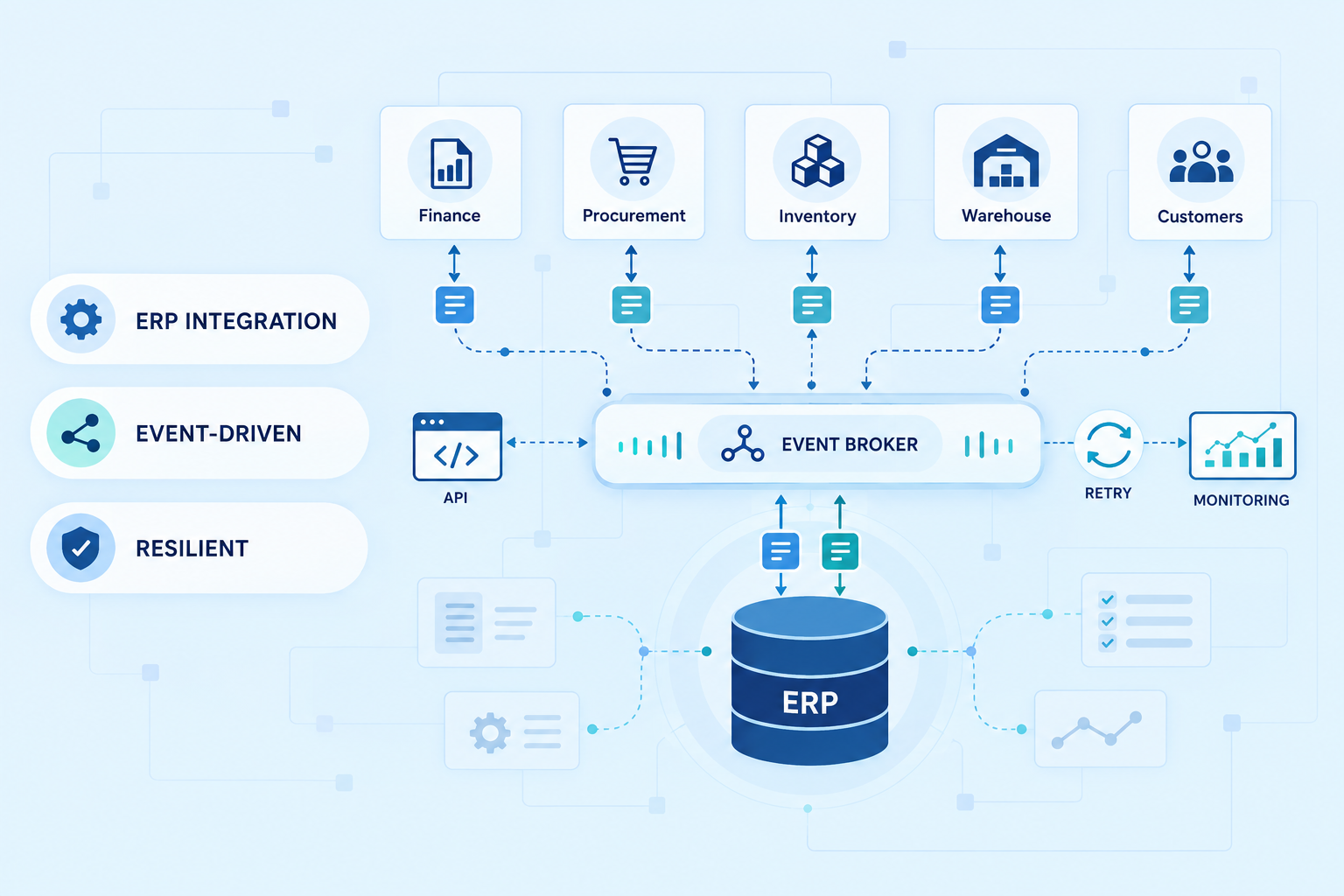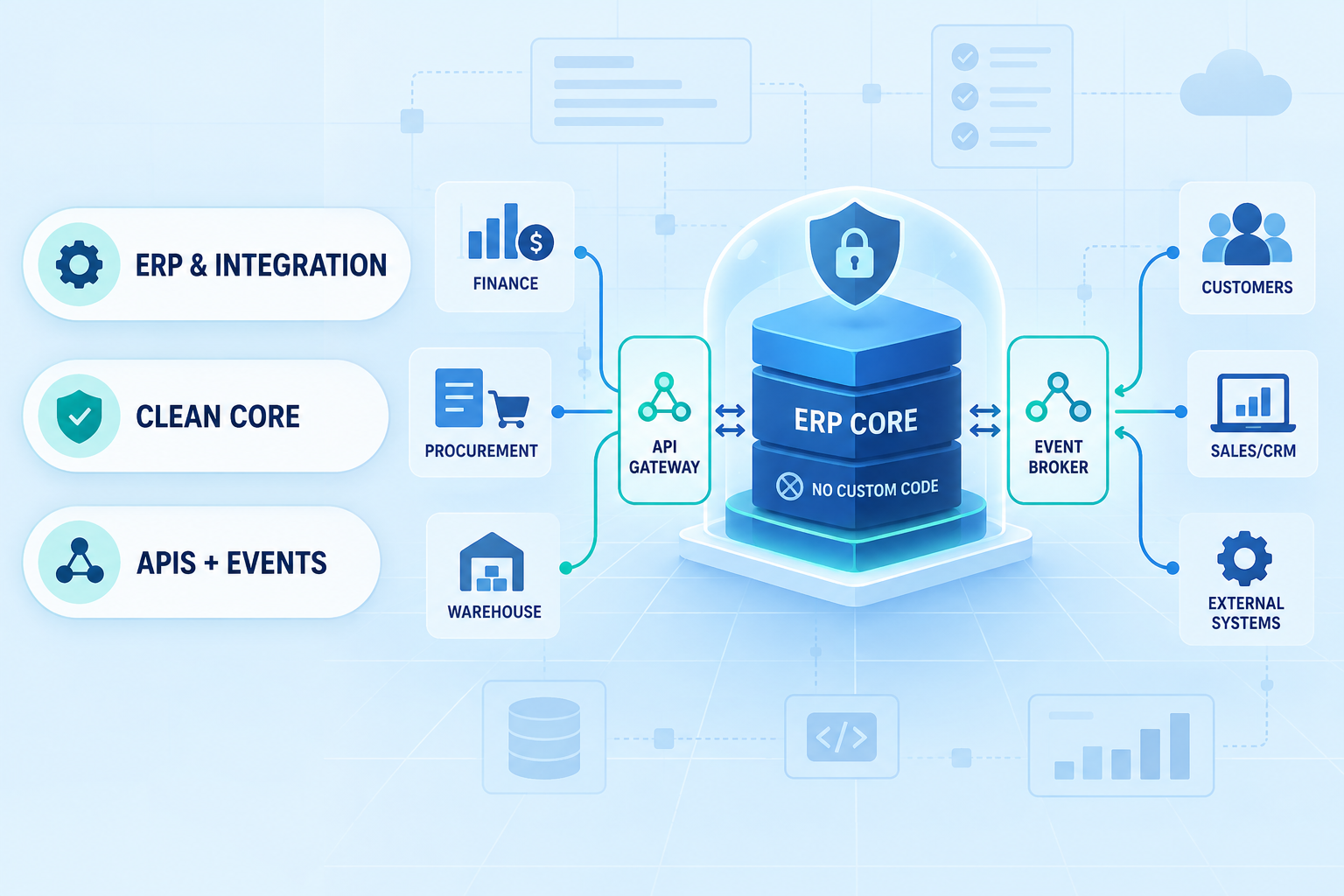


Legacy middleware rarely disappears because someone rewrites twenty interfaces as twenty unrelated cloud functions. That approach removes a license but replaces one platform with fragmented code, inconsistent retries and support knowledge scattered across teams. The enduring value of middleware is not its proprietary runtime; it is the repeatable integration patterns and operating model.
A recent AWS case study describes how Country Road Group replaced BizTalk and other tools with a pattern-driven platform organized into batch, API, database and event lanes. Reusable infrastructure modules, a common event backbone and unified error handling separated interface intent from execution technology. The exact services are optional; the platform principles are not.
Inventory behavior, not only endpoints
For every interface, record producer, consumer, protocol, schedule, payload, volume, latency, ordering, transformation, security, retry, replay, support owner and business criticality. Identify the actual pattern: file transfer, request-reply, publish-subscribe, content routing, aggregation or long-running orchestration.
Capture hidden behavior in old maps and scripts. A “simple” order file may encode duplicate suppression, partner-specific dates, sequence rules and month-end recovery. Migration fails when those rules are discovered after cutover.
Create a small pattern catalog
Define approved building blocks with inputs, outputs, failure semantics, observability, encryption, retention and cost expectations. A pattern should solve a recurring problem without exposing every underlying service option. Version modules and keep escape hatches reviewed and rare.
Do not create a universal mega-pattern. File batches, synchronous APIs, database extraction and asynchronous events have different operating characteristics. Standardize each lane while allowing appropriate runtime choices for short, long-running or stateful work.
Use a canonical event backbone carefully
A shared event bus can enable content routing, replay and decoupling, but canonical events need ownership. Define schemas, compatibility, identity, correlation and retention. Avoid forcing every source into one giant enterprise object. Use bounded business events with clear producers and consumers.
Make failed messages first-class data
Dead-letter queues often contain complete customer, employee or commercial payloads. Apply the same encryption, access, residency and retention controls as the primary channel. Store correlation ID, interface ID, error class, attempt history and payload reference in a common error contract.
Give trained operators a dashboard to inspect, correct where policy permits, and resubmit idempotently. Never encourage copy-paste reprocessing outside the platform. Separate transient retry from business-data correction and require approval for sensitive changes.
Build idempotency into every pattern
At-least-once delivery, timeouts and operator replay make duplicates inevitable. Define the business key, deduplication window and downstream behavior. Test a message that succeeds at the target but times out before acknowledgment. Financial, inventory and production documents must not double-post.
Standardize observability across lanes
Propagate one correlation ID through files, API calls, database jobs and events. Publish latency, throughput, failure, retry age and business completion metrics. Operators need an end-to-end transaction view, not separate dashboards for each cloud service.
Migrate by business wave
Group related interfaces so a business process can be tested end to end. Run contract tests and parallel reconciliation. Preserve service-group rollback rather than an all-or-nothing program. Start with representative complexity, not only the easiest interface, so platform gaps emerge early.
Control platform sprawl
Offer templates, CI/CD, policy checks and paved-road documentation. Require architecture review for new runtimes or bypasses. Track time to onboard, pattern reuse, exceptions, support effort and total cost. A platform succeeds when teams choose it because delivery is faster and recovery is safer.
Treat AI-generated integration as untrusted code
An assistant may help select or configure patterns, but schemas, permissions, transformations and failure behavior still require review and tests. Keep credentials out of prompts, constrain generated infrastructure to approved modules and validate destructive changes.
The takeaway: middleware modernization should preserve proven integration discipline while removing proprietary coupling. A small pattern catalog, common recovery model and migration waves can reduce cost and risk without creating a new generation of one-off interfaces.
From announcement to dependable operations
Start with a bounded business problem and an accountable owner. Record the current cost, delay, failure rate, and manual work before changing the architecture. Define a measurable outcome, but do not present an estimate as guaranteed savings. Include security, finance, operations, and the people who will support exceptions after launch.
Map the current workflow before selecting technology. Identify the source of truth, approval points, downstream consumers, sensitive data, recovery objectives, and every manual workaround. Decide which step the new capability improves and which steps remain unchanged. This prevents a demonstration from being mistaken for an end-to-end operating solution.
Build a representative pilot with real permissions, data volume, dependency behavior, and user roles. Test peak demand, missing data, stale configuration, denied access, duplicate input, partial failure, recovery, and rollback. Document what continues when the new capability is unavailable. Keep an approved manual path for high-consequence decisions.
Security must be part of the design. Use separate workload identities, short-lived credentials, least privilege, encrypted transport and storage, controlled secrets, and auditable administrative access. Treat retrieved documents, event payloads, model output, and third-party responses as untrusted input. Validate every action at the boundary where it affects money, data, equipment, customers, or regulated records.
Cost controls need similar depth. Tag usage to a product and owner, define budgets and anomaly thresholds, measure cost per successful business outcome, and include integration, support, data movement, licensing, and training. A lower infrastructure bill can be offset by more exceptions or human correction. Evaluate total process cost rather than one service price.
Operate the result like a product. Monitor availability, latency, unit cost, data quality, security findings, user adoption, exceptions, and support effort. Version configurations and decision rules. Log changes and approvals. Review whether the capability still solves the original problem as prices, products, and workflows evolve.
Prepare the support model before launch. Give responders dashboards, runbooks, ownership, escalation paths, and safe diagnostic access. Alert on stale data and silent degradation, not only complete failure. Practice a dependency outage and verify that queued work, retries, reconciliation, and user communication behave as designed.
Change management is also technical risk control. Explain what users should trust, what they must verify, and how they report a wrong result. Train with real scenarios and capture overrides as useful feedback. Do not measure adoption by logins alone; measure whether the process becomes faster, safer, or more accurate.
Maintain a decision record that states why the technology was selected, which alternatives were considered, which risks were accepted, and what would trigger redesign or retirement. Review it after incidents and major vendor changes. Portability does not require avoiding managed services; it requires knowing which data, contracts, identities, and operational procedures must survive a change.
Expansion should follow evidence. Compare the pilot with its baseline, include the cost of integration and governance, and retire components that no longer earn their complexity. A new feature creates value only when teams can understand it, control it, recover it, and improve it without depending on one specialist.
Finally, schedule a formal review after thirty and ninety days. Ask whether users changed behavior, whether exceptions moved elsewhere, and whether actual costs match the forecast. Publish the findings to sponsors and delivery teams. If value is weak, narrow the scope or stop. Responsible innovation includes the ability to end an experiment cleanly.
Sources
- AWS Architecture Blog — Pattern-driven integration at Country Road Group
- AWS Samples — Enterprise Integration Patterns CDK implementation guide
Build it with Cogniquaint experts
Cogniquaint’s ERP and integration experts can discover legacy interface behavior, design a pattern catalog and canonical contracts, build secure error recovery and observability, automate reusable infrastructure, and migrate business waves with reconciliation and rollback alongside your application teams.
Work with Cogniquaint
Ready to elevate your operations with AI-powered insights?
Get in touch with us to build your next intelligent solution.