
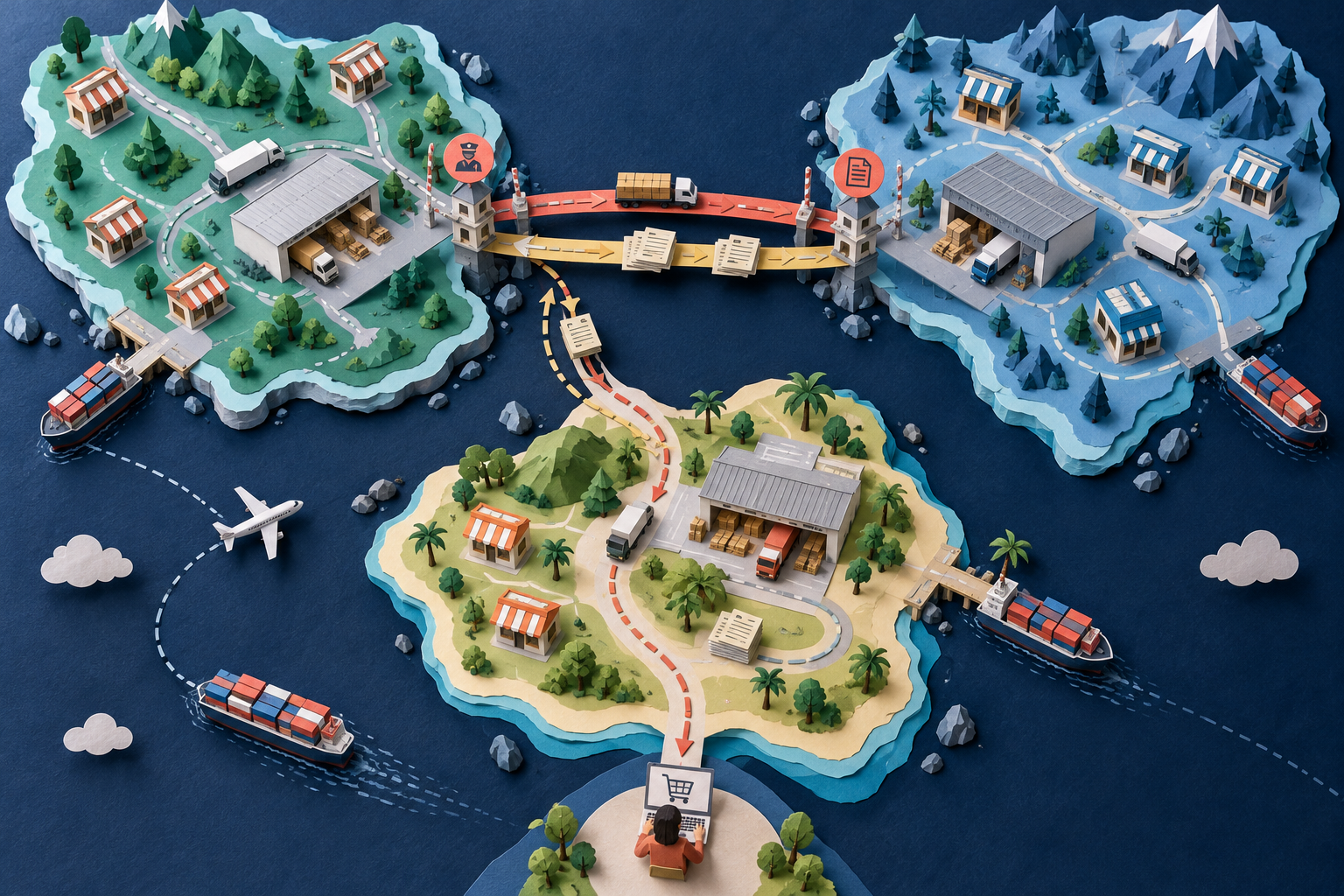
A retailer may show an item unavailable in one company even while another legal entity owns suitable stock nearby. Dynamics 365 Commerce now documents cross-legal-entity fulfillment in preview: distributed order management can consider stores and warehouses from participating entities and create the intercompany purchase and sales orders required to execute the choice. The capability can widen inventory options without asking employees to coordinate transactions manually.
The best physical location is not always the best legal or economic answer. Cross-company fulfillment touches tax, transfer pricing, ownership, payment, returns and financial close. Optimization must operate inside those rules.
Define the eligible network
Choose participating legal entities, locations, products, sales origins and delivery modes deliberately. Products must be released consistently, intercompany trading relationships established, and location coordinates trustworthy. Do not expose every warehouse merely because it exists. Preserve minimum stock for local demand and exclude regulated or restricted flows.
Model the full landed cost
Distance is only one factor. Include shipping, handling, intercompany transfer, duties, tax, currency, split-order cost and expected return handling. Use effective dates and owners for every cost input. Compare the optimized plan with actual invoices and freight; otherwise the engine can optimize stale assumptions.
Protect inventory truth
Cross-company availability needs consistent units, variants, reservations and update timing. Test concurrent orders, cancelled reservations and delayed warehouse confirmation. Define which system owns available-to-promise and how quickly a failed fulfillment choice releases stock.
Reconcile the document chain
One customer order may generate fulfillment plans, warehouse work, shipment, intercompany purchase and sales orders, customer invoicing and settlement. Carry a correlation identifier across the chain. Monitor missing counterparts, amount or quantity mismatches, stuck statuses and duplicate creation. Finance and operations need the same exception view.
Design returns before launch
A customer may return to the selling entity while inventory originated elsewhere. Decide disposition, ownership transfer, tax correction, refund and reverse logistics. Include damaged goods, partial shipments and exchanges. A fast outbound journey that creates manual returns can raise total cost.
Pilot the preview responsibly
Microsoft labels the capability preview, so functionality and timing may change. Use a limited entity pair and product group, keep human review of early plans, and version configuration. Measure fulfillment rate, delivery time, splits, intercompany exceptions, gross margin and support effort.
The practical takeaway: cross-entity optimization turns idle stock into a network option only when accounting and operational controls travel with the product. Treat it as an end-to-end ERP process, not a clever sourcing rule.
From announcement to dependable operations
Start with a bounded business problem and an accountable owner. Record the current cost, delay, failure rate, and manual work before changing the architecture. Define a measurable outcome, but do not present an estimate as guaranteed savings. Include security, finance, operations, and the people who will support exceptions after launch.
Map the current workflow before selecting technology. Identify the source of truth, approval points, downstream consumers, sensitive data, recovery objectives, and every manual workaround. Decide which step the new capability improves and which steps remain unchanged. This prevents a demonstration from being mistaken for an end-to-end operating solution.
Build a representative pilot with real permissions, data volume, dependency behavior, and user roles. Test peak demand, missing data, stale configuration, denied access, duplicate input, partial failure, recovery, and rollback. Document what continues when the new capability is unavailable. Keep an approved manual path for high-consequence decisions.
Security must be part of the design. Use separate workload identities, short-lived credentials, least privilege, encrypted transport and storage, controlled secrets, and auditable administrative access. Treat retrieved documents, event payloads, model output, and third-party responses as untrusted input. Validate every action at the boundary where it affects money, data, equipment, customers, or regulated records.
Cost controls need similar depth. Tag usage to a product and owner, define budgets and anomaly thresholds, measure cost per successful business outcome, and include integration, support, data movement, licensing, and training. A lower infrastructure bill can be offset by more exceptions or human correction. Evaluate total process cost rather than one service price.
Operate the result like a product. Monitor availability, latency, unit cost, data quality, security findings, user adoption, exceptions, and support effort. Version configurations and decision rules. Log changes and approvals. Review whether the capability still solves the original problem as prices, products, and workflows evolve.
Prepare the support model before launch. Give responders dashboards, runbooks, ownership, escalation paths, and safe diagnostic access. Alert on stale data and silent degradation, not only complete failure. Practice a dependency outage and verify that queued work, retries, reconciliation, and user communication behave as designed.
Change management is also technical risk control. Explain what users should trust, what they must verify, and how they report a wrong result. Train with real scenarios and capture overrides as useful feedback. Do not measure adoption by logins alone; measure whether the process becomes faster, safer, or more accurate.
Maintain a decision record that states why the technology was selected, which alternatives were considered, which risks were accepted, and what would trigger redesign or retirement. Review it after incidents and major vendor changes. Portability does not require avoiding managed services; it requires knowing which data, contracts, identities, and operational procedures must survive a change.
Expansion should follow evidence. Compare the pilot with its baseline, include the cost of integration and governance, and retire components that no longer earn their complexity. A new feature creates value only when teams can understand it, control it, recover it, and improve it without depending on one specialist.
Finally, schedule a formal review after thirty and ninety days. Ask whether users changed behavior, whether exceptions moved elsewhere, and whether actual costs match the forecast. Publish the findings to sponsors and delivery teams. If value is weak, narrow the scope or stop. Responsible innovation includes the ability to end an experiment cleanly.
Sources
- Microsoft Learn — Cross-legal-entity fulfillment with DOM
- Microsoft Learn — Distributed order management overview
Build it with Cogniquaint experts
Cogniquaint’s ERP and integration experts can map legal-entity flows, harmonize product and inventory data, configure fulfillment rules, connect intercompany documents, design returns and reconciliation, and validate whether broader stock access improves service at an acceptable total cost.
Work with Cogniquaint
Ready to elevate your operations with AI-powered insights?
Get in touch with us to build your next intelligent solution.